A restaurant kitchen doesn't run on one cutting board. The board you need at the butcher station — thick, heavy, built to take a cleaver — is not the board you pass across the pass for a cheese course. This guide breaks down the best boards by station, from heavy prep to tableside presentation, so you can outfit an entire kitchen from a single supplier.
Quick picks by station:
Butcher station & heavy prep → End-grain red oak butcher block (NSF-certified)
High-volume prep & line work → End-grain bamboo chopping board (economical, food-safe)
Cheese & charcuterie service → Marble & acacia cheese board set
Tableside presentation → Marble & acacia serving board
Multi-station & wholesale → Acacia cutting board set (3 sizes)
Before you buy, it helps to separate what a board actually does in a commercial kitchen into two jobs.
Prep boards take a beating. They get a knife edge driven into them hundreds of times a shift. What matters here is hardness, thickness, and how the board handles a blade — not how it photographs.
Serving boards get seen. They carry a cheese course or a carved roast to the table, so material, finish, and appearance matter as much as function.
Most suppliers specialize in one or the other. A factory that makes both — in food-safe materials, at wholesale MOQs — saves you from juggling vendors and keeps your kitchen's boards visually consistent.
The standard advice in commercial kitchens is to use color-coded plastic boards for raw proteins, and that advice is sound — HACCP color coding is the simplest way to prevent cross-contamination on the protein line. But plastic is a poor default for everything else.
On the knife. Hard plastic dulls edges faster than wood or bamboo, and a dull knife is a safety hazard. End-grain wood and bamboo are gentler on steel.
On the surface. Wood and bamboo have natural antimicrobial properties and self-heal; a gouged plastic board stays gouged and traps bacteria in the cut.
On the plate. Plastic looks like plastic. Wood, bamboo, and marble are the materials your front-of-house staff actually want to carry to a table.
The right setup is not "wood vs. plastic" — it's plastic on the raw-protein line, and wood, bamboo, or marble everywhere else.
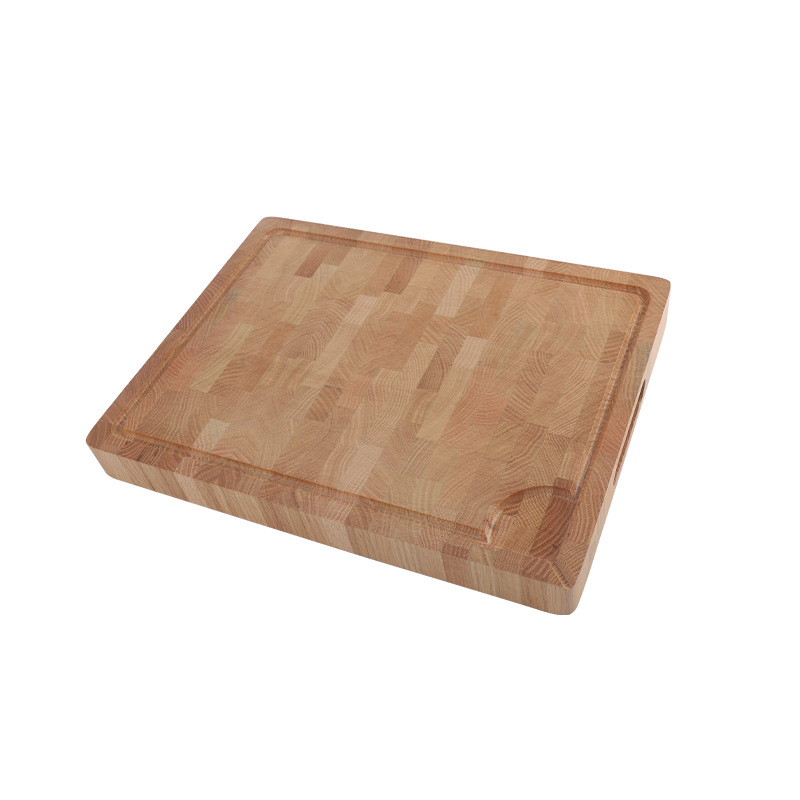
For the heaviest prep — breaking down primal cuts, splitting, anything a cleaver touches — you want a thick end-grain board that won't flex or split. Red oak is a dense hardwood (roughly 0.75 g/cm³) that stands up to years of hard use, and its end-grain construction lets the knife land between the wood fibers rather than against them.
| Spec | Detail |
|---|---|
| Material | Red oak hardwood |
| Construction | End grain |
| Size | 15.75 × 11.81 × 1.18 in (custom sizes available) |
| Certification | NSF |
| MOQ | 100 units |
| Best for | Butcher station, heavy prep |
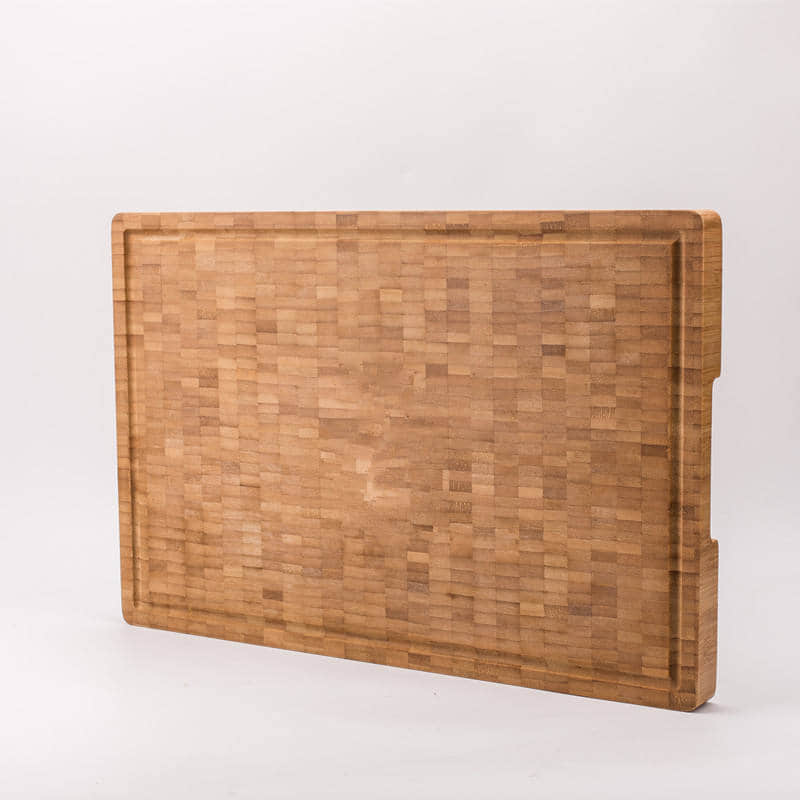
Bamboo is technically a grass, not a wood, but its fibers are dense and hard, which makes it a durable board at a cost that works for a busy line. This board gives you a wide, thick working surface without the price of hardwood — the board you buy several of and replace when needed.
| Spec | Detail |
|---|---|
| Material | Bamboo |
| Construction | End-grain bamboo |
| Size | 17.72 × 11.81 × 1.50 in (custom available) |
| Certification | FDA food-contact safe |
| MOQ | 200 units |
| Best for | High-volume prep, line work |
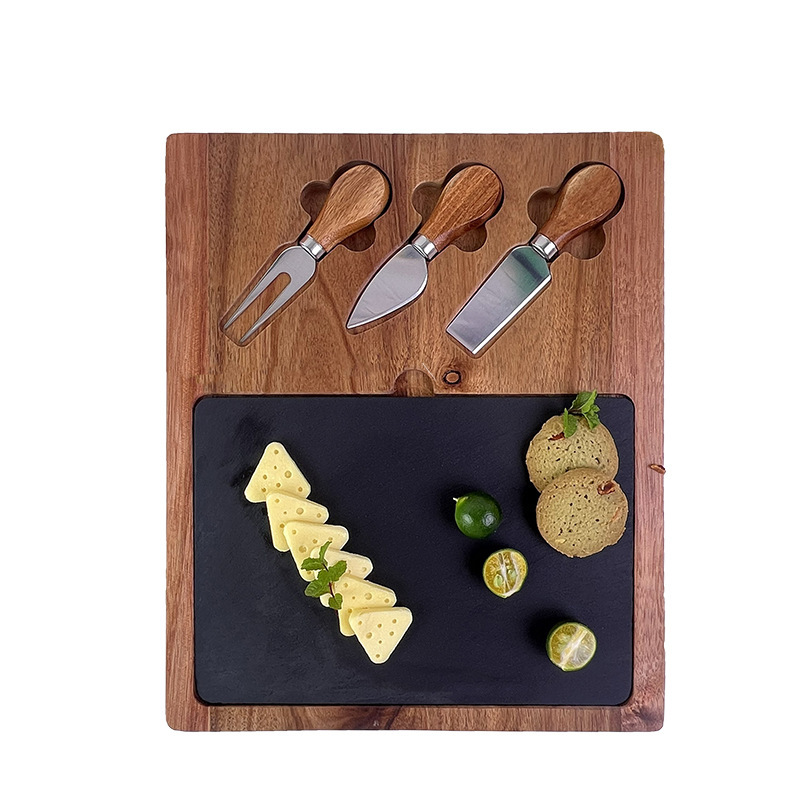
For the cheese course, marble is the material that works: it stays cool, which keeps cheese and charcuterie at the right temperature through service. This set pairs a natural marble surface with an edge-grain acacia frame and dedicated slots for three cheese knives, so the whole station is one piece.
| Spec | Detail |
|---|---|
| Material | Acacia wood + natural marble |
| Construction | Edge-grain acacia |
| Size | 13.31 × 11.02 × 0.59 in |
| Certification | FDA food-contact safe |
| MOQ | 150 units |
| Best for | Cheese & charcuterie service |
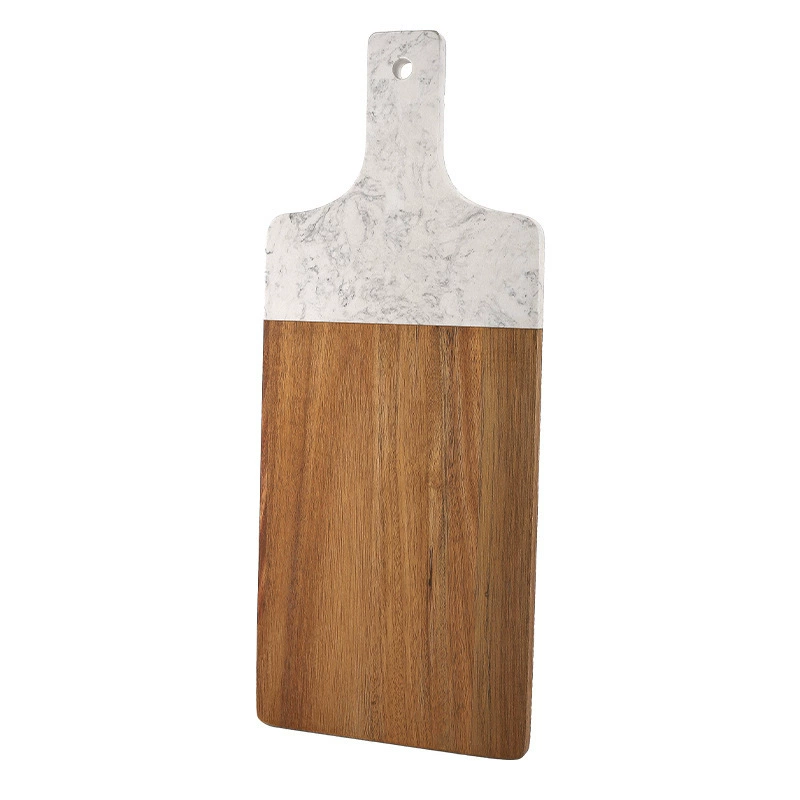
Some boards leave the kitchen. This one is built to be carried out: a marble slab joined to an acacia base with a comfortable handle, sized and weighted for plated courses. A food-grade oil-and-wax finish keeps the wood safe for direct food contact and easy to wipe clean between covers.
| Spec | Detail |
|---|---|
| Material | Acacia wood + marble |
| Construction | Edge grain |
| Size | 17.32 × 7.09 × 0.51 in |
| Finish | Food-grade wood oil / wax |
| Certification | FDA food-contact safe |
| MOQ | 200 units |
| Best for | Tableside presentation, platters |
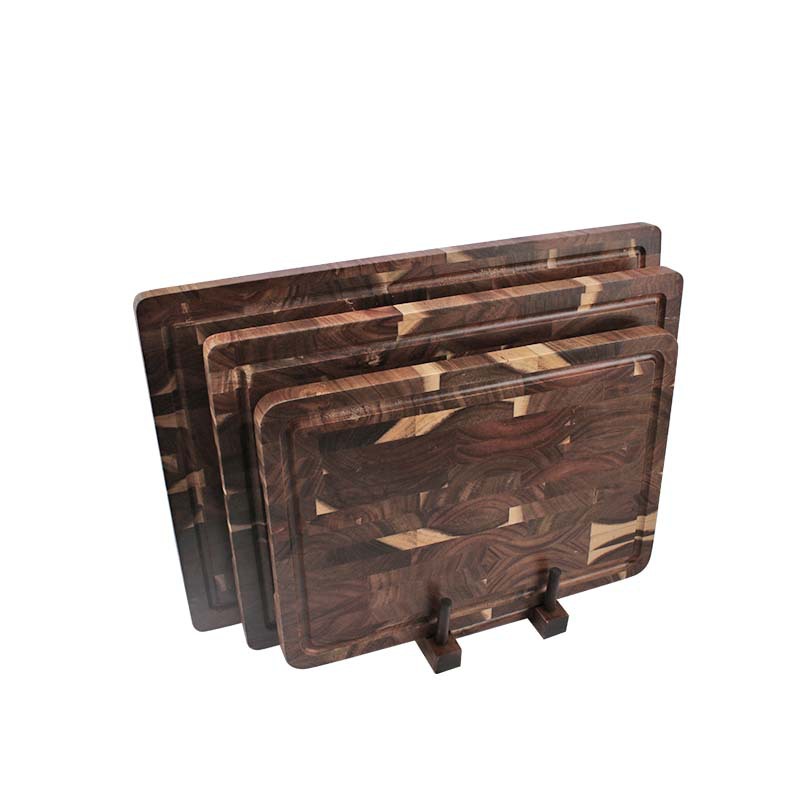
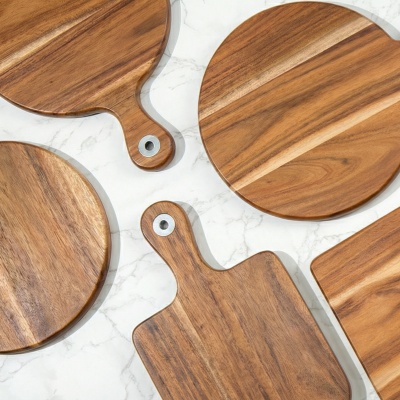
If you're outfitting several stations — or you're a distributor stocking a wholesale cutting board line — this three-piece acacia set covers it. Acacia is a dense hardwood with natural water resistance, and the set comes in three graduated sizes so every station gets the right board from one order.
| Spec | Detail |
|---|---|
| Material | Acacia wood |
| Sizes | 16.93×11.02×0.75 in · 14.96×10.24×0.75 in · 12.99×9.06×0.75 in |
| Finish | Food-safe finish |
| MOQ | 200 units |
| Lead time | 20–30 days |
| Best for | Multi-station use, wholesale sets |
Five things to check before you commit to a supplier.
Match the material to the job. Hardwood (oak, acacia, rubberwood) for heavy cutting and butcher work. Bamboo for economical, food-safe line boards you can stock in quantity. Marble for cold service — cheese, charcuterie, and plated courses that benefit from a cool surface. We work in all three, and source our hardwood from North America and Southeast Asia.
End-grain boards are made with the wood fibers facing up, so the knife slides between fibers instead of cutting across them. They're gentler on edges and self-heal, which is why they're the standard for butcher stations. Edge-grain boards are more affordable and perfectly fine for lighter prep and serving. Buy end grain where the knife work is heavy, edge grain everywhere else.
For a commercial kitchen, certifications aren't optional. Our butcher block is NSF-certified, and our bamboo, acacia, and marble boards are made from FDA food-contact safe materials. Documentation is provided with bulk orders.
Commercial boards have to survive the dishwasher, the drop, and the daily grind. Our hardwood and bamboo is kiln-dried for 45–50 days before it's machined, which stabilizes the wood so boards resist warping and cracking under restaurant conditions.
If you're a restaurant group, a distributor, or a brand buying to resell, the terms matter as much as the board. Our MOQs start at 100–200 units depending on the line, standard lead time runs 20–30 days, and OEM orders run 30–45 days. We customize almost everything — laser engraving, sizes, packaging, hardware — so you can sell under your own brand.
Are bamboo cutting boards safe for restaurant use?
Yes. Bamboo is dense, hard, and food-safe, and our bamboo boards are FDA food-contact safe. They're a common, economical choice for line work and high-volume prep in commercial kitchens.
What board should I use at the butcher station?
A thick end-grain hardwood board. Our red oak butcher block is NSF-certified and built for heavy cutting — end grain so it's gentle on knives and dense enough not to flex under a cleaver.
Can I get custom sizes and private-label boards?
Yes. We run OEM and private-label programs with laser engraving, custom dimensions, packaging, and hardware. MOQ for custom orders is typically 200 units and can be flexible — contact us for a quote.
We're based in Yangjiang, Guangdong — China's kitchenware manufacturing hub — and we've been producing cutting and serving boards since 2015. We run four production lines with a capacity of 20,000–50,000 boards per month (depending on material and size), and we kiln-dry our hardwood and bamboo in-house for 45–50 days to keep boards stable. Our boards ship to retailers across North and South America.
We build boards for brands, not just our own line. Laser-engraved logos, custom sizes, custom packaging, and hardware are all available. OEM MOQs are typically 200 units and flexible for smaller runs, with 30–45 day lead times.
Tell us the stations you're outfitting, the quantity, and whether you need your own branding, and we'll send board specs and pricing. Fill out the inquiry form on this page, or email us at [email protected].