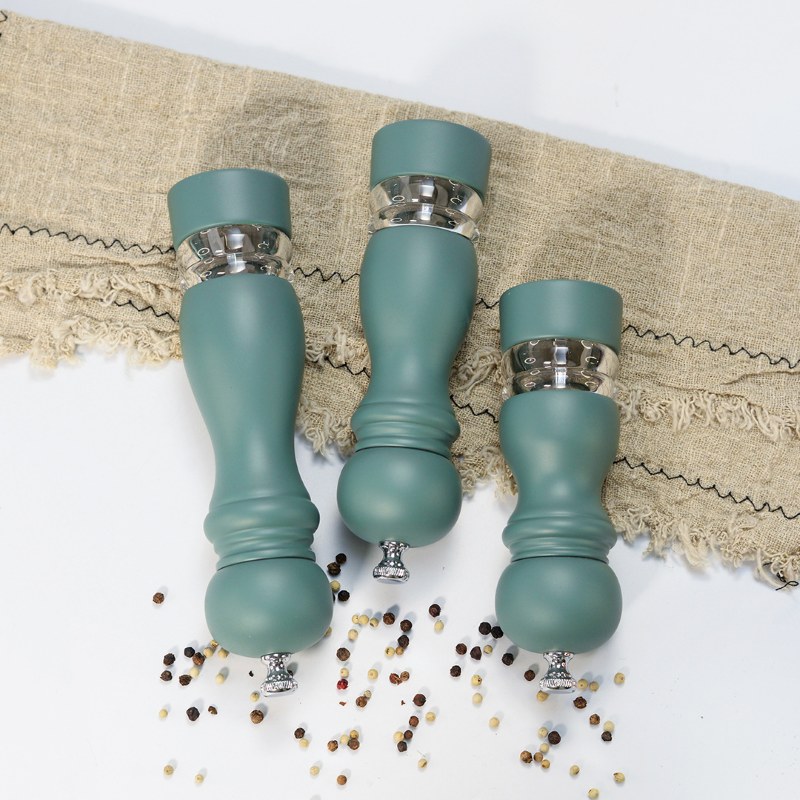
A pepper mill is judged by its shell, but it lives or dies by the core inside it. And here's the detail most buyers miss: salt corrodes steel. The classic steel-burr mills that top every "best pepper mill" list are pepper-only — run salt through them and the burr rusts and leaves a metallic taste. The fix is a mill built around a ceramic grinding core, which grinds both salt and pepper without rusting, without adding taste, and without forcing you to buy two different mechanisms. This guide covers the best wooden salt and pepper mill sets we build — and what to check before you stock them.
Quick picks:
Color-forward sets → PU spray-painted acacia mill set (three sizes)
Metal + wood sets → Stainless-steel-head acacia mill set (golden cap)
Single, Nordic minimal → Gradient white rubberwood pepper mill
Single, decorative → Nordic ceramic & rubberwood pepper mill
Before you compare bodies, compare burrs. The burr — the mechanism that actually crushes the peppercorn — is the one part that decides how a mill grinds, how long it lasts, and whether it can handle salt at all.
Steel burrs are sharp and aggressive, which is why premium brands such as Peugeot and Cole & Mason use them for pepper. But salt is corrosive: run salt through a steel mechanism and it rusts the burr, seizes the action, and can leave a metallic taste in the food. That's the real reason the "salt and pepper mill" sets from those brands pair two different mechanisms — steel for pepper, and a separate corrosion-proof core for salt.
A ceramic core sidesteps the problem entirely. Ceramic doesn't rust, doesn't react with salt, and doesn't transfer any taste. One mechanism grinds both salt and pepper, so you don't need to stock two different mills or two different spare parts. Ours is a non-electroplated ceramic burr, fired at high temperature, so it's heat- and cold-resistant and holds its edge through years of daily grinding.
Pair that with a stepless adjustment — turn the knob clockwise for fine powder, counter-clockwise for coarse flakes — and you get a mill that moves cleanly from table salt to steak au poivre without swapping settings.
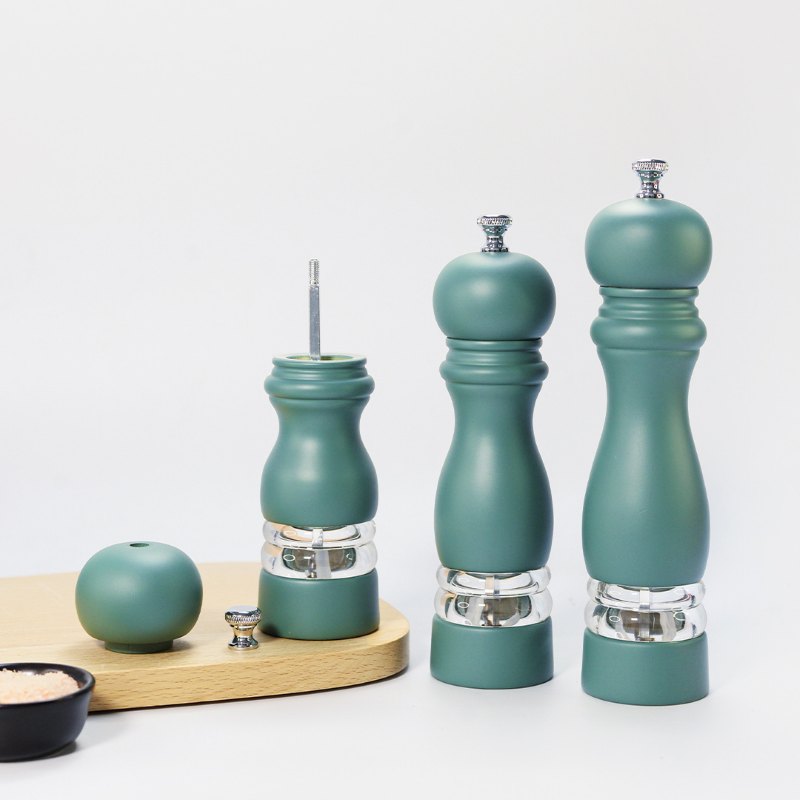
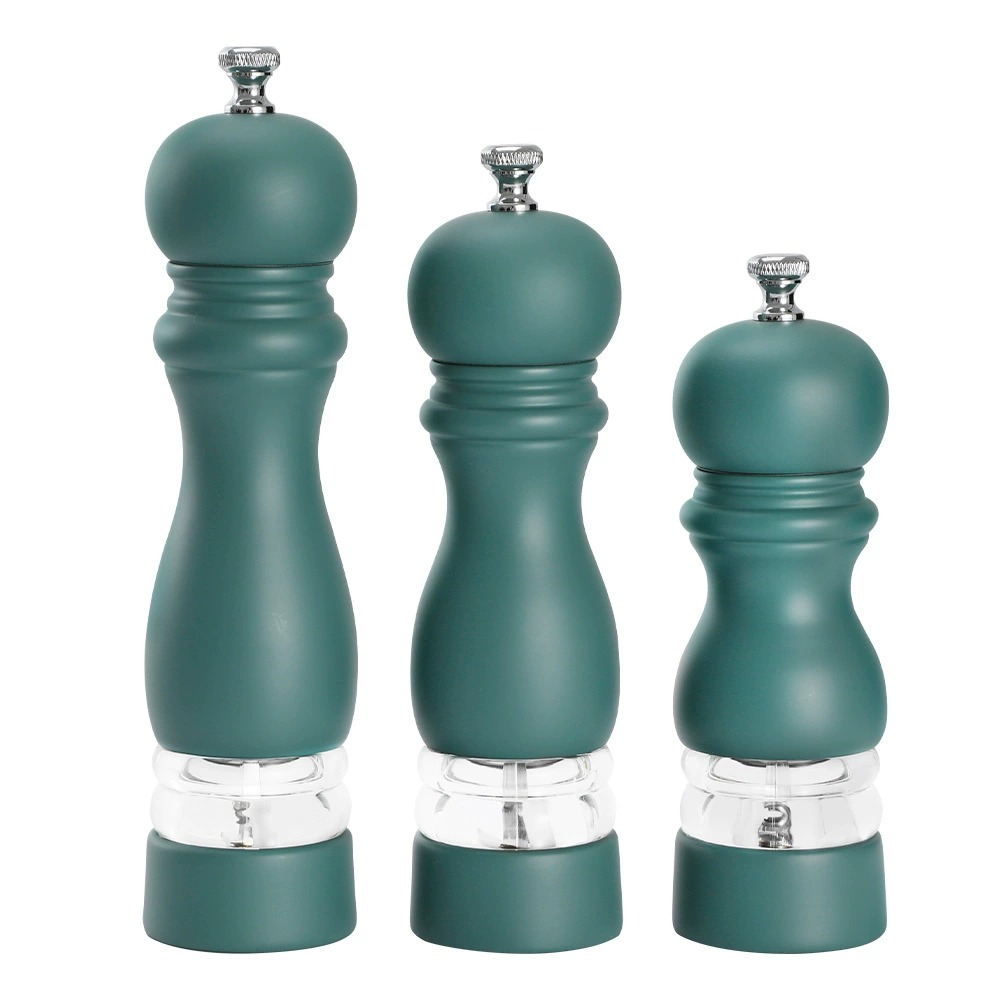
A three-piece set in three graduated heights, turned from solid acacia and finished in smooth PU spray paint, with an acrylic window so you can see the peppercorn level at a glance. Acacia is a dense, fast-growing hardwood that takes a clean edge and stands up to daily use, and the one-piece turned body means there are no glued seams to crack. The soft blue palette sits well on a modern table — practical for grinding, decorative enough to leave out.
| Spec | Detail |
|---|---|
| Material | Acacia hardwood |
| Grinding core | Ceramic |
| Adjustment | Stepless (clockwise fine / counter-clockwise coarse) |
| Sizes | 8.7 in, 7.7 in, 6.5 in heights (2.0 in diameter) |
| Construction | One-piece turned |
| Finish | PU spray paint |
| MOQ | 300 units |
| Lead time | 25 days |
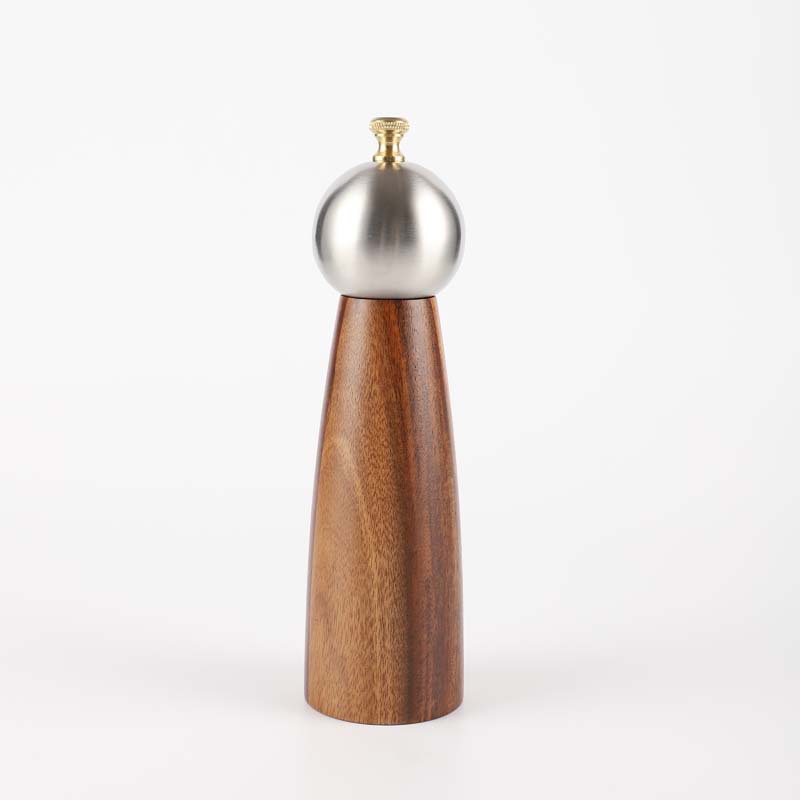
If you want the warmth of wood with the weight of metal, this set pairs a solid acacia body with a brushed stainless-steel head and a gold-toned cap. The metal head gives it a premium feel and a smooth, non-slip grip, while the wooden body keeps the natural grain. The wood is sanded and the stainless is matte, so the piece reads as intentional rather than appliance-like.
| Spec | Detail |
|---|---|
| Material | Stainless steel head + acacia body |
| Grinding core | Ceramic |
| Adjustment | Stepless (clockwise fine / counter-clockwise coarse) |
| Sizes | 6 in, 8 in, 9 in heights |
| Construction | One-piece turned |
| Finish | Natural wood + matte stainless steel |
| Certification | FDA food-contact safe |
| MOQ | 260 units |
| Lead time | 25–30 days |
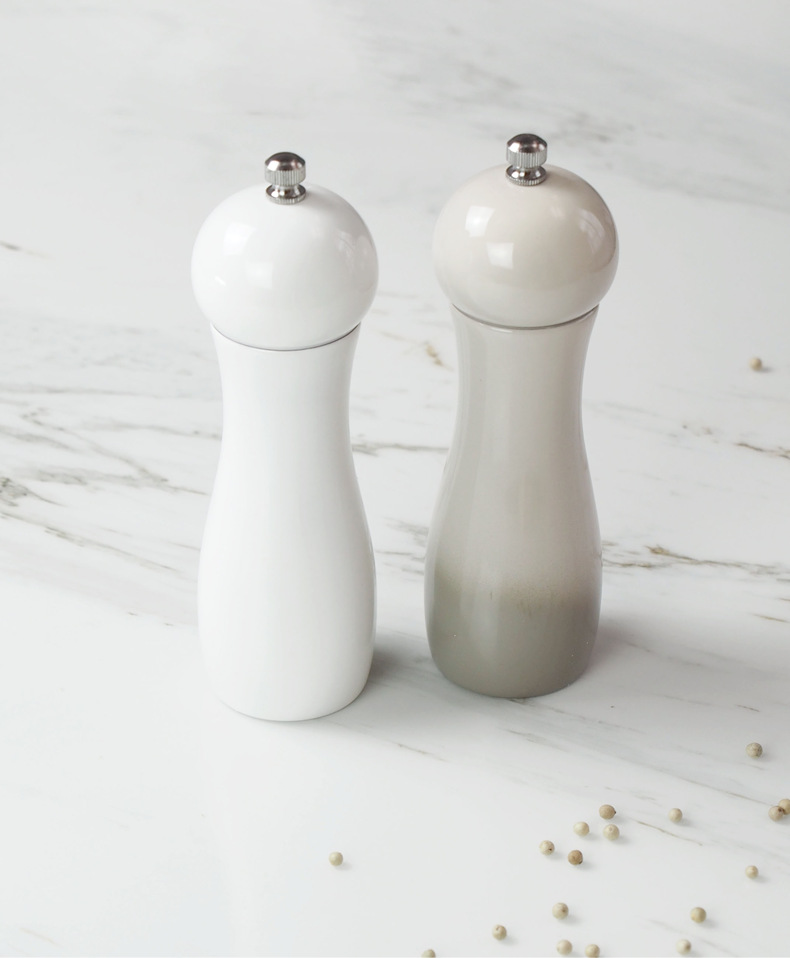
A single mill in a quiet, Nordic-leaning design: a gradient white finish over a thick-walled rubberwood body. Rubberwood is a genuinely sustainable hardwood — a byproduct of the rubber latex industry — and it's dense enough to resist cracking under the clamp force of the grinder. This is the mill for a clean, minimalist counter or a tableside setting where the tool shouldn't shout.
| Spec | Detail |
|---|---|
| Material | Rubberwood |
| Grinding core | Ceramic |
| Adjustment | Stepless (clockwise fine / counter-clockwise coarse) |
| Size | 6 in height (1.8 in diameter) |
| Construction | One-piece turned |
| Finish | Painted (gradient white / beige) |
| Certification | FSC, FDA, LFGB |
| MOQ | 250 units |
| Lead time | 15–20 days |
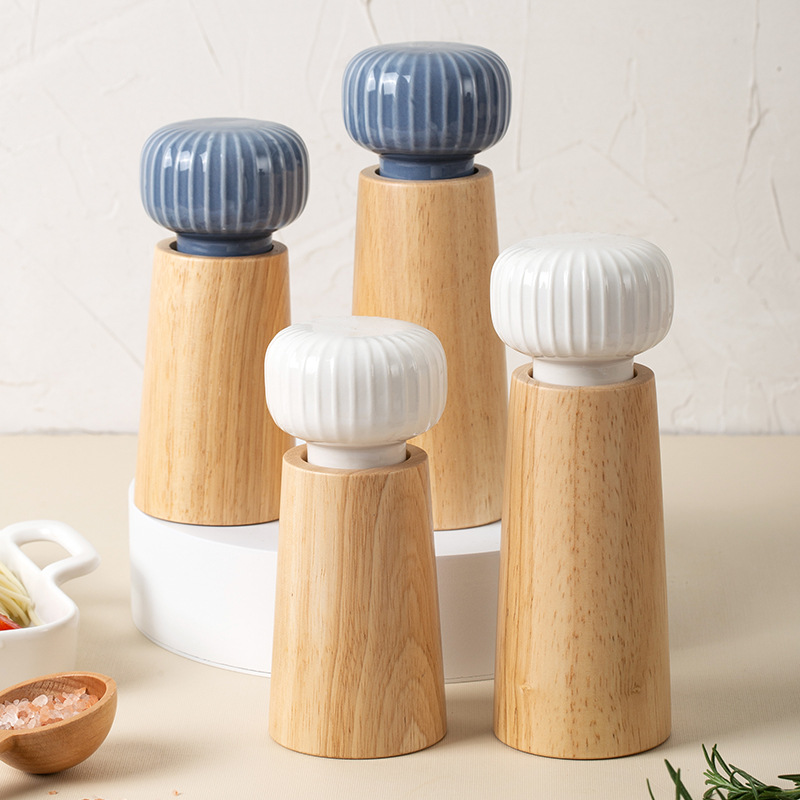
A decorative mill that still grinds properly: a ceramic head — available in white or indigo — seated on a natural rubberwood body. The ceramic head adds weight and a cool, matte contrast to the wood, and it doubles as a display piece between uses. Three heights let you size it to the table or the shelf.
| Spec | Detail |
|---|---|
| Material | Ceramic head + rubberwood body |
| Grinding core | Ceramic |
| Adjustment | Stepless (clockwise fine / counter-clockwise coarse) |
| Sizes | 6 in, 7 in, 8 in |
| Construction | One-piece turned |
| Finish | Natural wood + ceramic head (white / indigo) |
| Certification | FDA food-contact safe |
| MOQ | 300 units |
| Lead time | 30 days |
Grinding core. Ask about this first, before material or color. Ceramic cores are corrosion-proof and grind both salt and pepper; steel and carbon steel are pepper-only unless paired with a separate salt mechanism. If a set is labeled "salt and pepper," ask whether both mills share the same corrosion-proof core.
Adjustment. Stepped adjustment gives you preset notches; stepless lets you dial in any coarseness between fine and coarse. For a restaurant or a serious home kitchen, stepless is more flexible.
Body material. A wooden pepper mill should be built from acacia or rubberwood — both sustainable hardwoods that machine cleanly and hold up to daily use. Rubberwood, in particular, is a latex-industry byproduct — a genuinely eco-friendly choice if your customers ask about sourcing.
Construction. One-piece turned bodies — rather than glued or laminated blanks — are stronger and won't separate at a seam after years of tightening.
Finish & certification. Look for food-contact certifications (FDA and LFGB are the standards to ask for) and a finish that's sealed and easy to wipe clean between uses.
MOQ, lead time & customization. If you're a retailer, distributor, or brand, the terms matter as much as the mill. Ours start at 250–300 units depending on the model, with 15–30 day lead times, and we customize nearly everything: laser-engraved logos, custom sizes, custom grinding cores and settings, and custom packaging.
Can a ceramic core really grind salt?
Yes — that's the point of it. Ceramic doesn't rust or react with salt, so one core handles both salt and pepper without the metallic taste you get from a corroded steel burr.
How long does a ceramic grinding core last?
Ours is fired at high temperature rather than electroplated, which makes it dense and heat- and cold-resistant. It holds its edge through years of daily use.
Can I get custom sizes and private-label mills?
Yes. We run OEM and private-label programs with laser engraving, custom dimensions, custom cores and settings, and custom packaging. MOQs are flexible — contact us for a quote.
Maytree Kitchenware is a kitchenware manufacturer based in Yangjiang, Guangdong — China's kitchenware manufacturing hub — producing 50,000 pepper and spice mills a month across our line. Every mill is built around the same corrosion-proof ceramic core and stepless adjustment, and finished to order.
Request a quote. Tell us the sizes you need, whether you want sets or single mills, and whether you need your own branding, and we'll send specs and pricing. Fill out the inquiry form on this page, or email us at [email protected].